
Soldered brass, 2008.
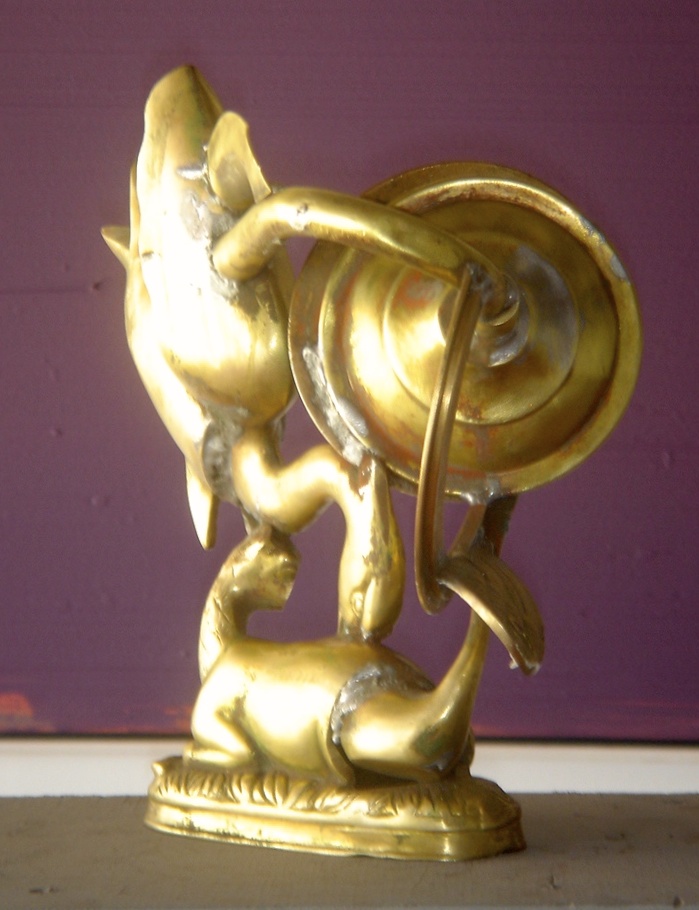
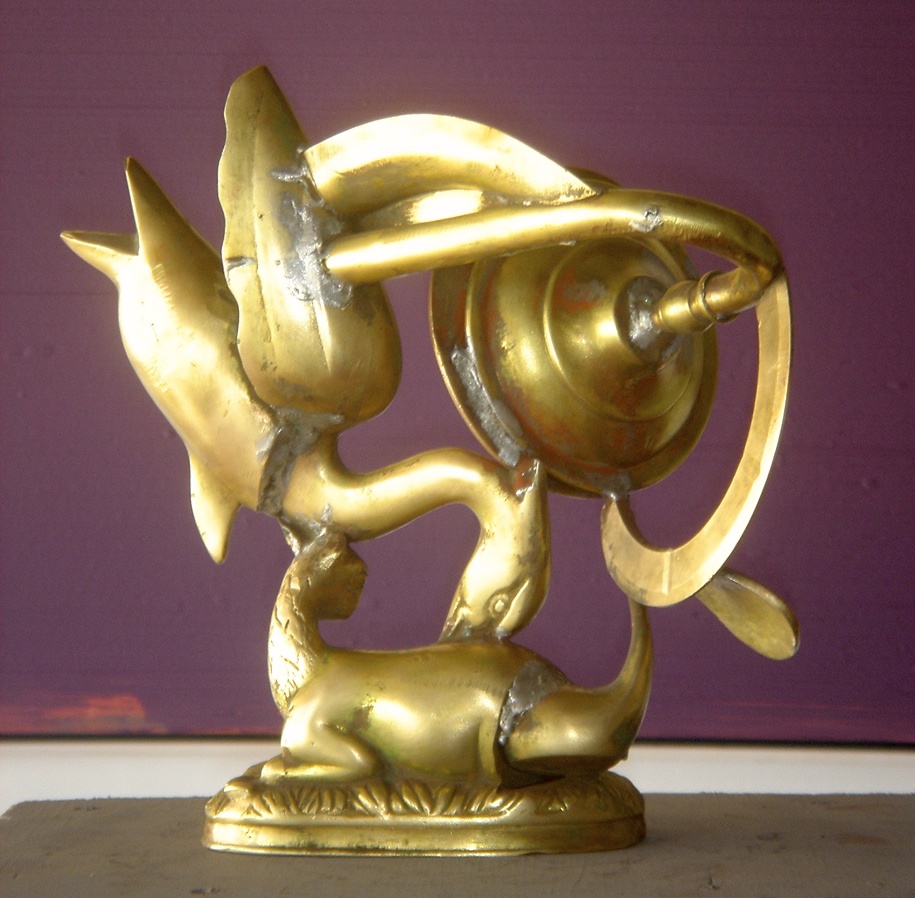
Cygnus + Phaeton gives the two halves of a myth their own forms and puts them in one composition. Phaethon, the son of the sun god Helios, borrowed his father’s chariot for a day and lost control of the horses. The earth caught fire, and Zeus brought him down with a thunderbolt into the river Eridanus. In Ovid’s telling, Cygnus is Phaethon’s kinsman and closer still in affection. He dives into the river again and again to find the body, and the gods turn him into a swan.
The swan in the sculpture is mid-dive: neck bent down, head pointed at the base, tail in the air. The sun is a stepped disc tipped well off its axis, with a hoop swinging loose from it and a small paddle-shaped piece trailing below. It reads as a wheel torn from its chariot, hanging at the height the swan plunges from. Phaethon’s name means “the shining one,” and the shining thing here has lost its course.
The base is oval and edged with grass, a riverbank, with a reclining animal at rest on it. It’s the only still part of the piece. Everything above it is falling, turning or pouring downward. Ovid’s Cygnus keeps to pools and lakes afterward and avoids the sky, so his transformation chooses water against the fire that killed his friend. The plus sign in the title carries the structure of the story: one figure falls, and another goes in after him.

