Painted welded steel, 30 x 21 x 17, 2005.
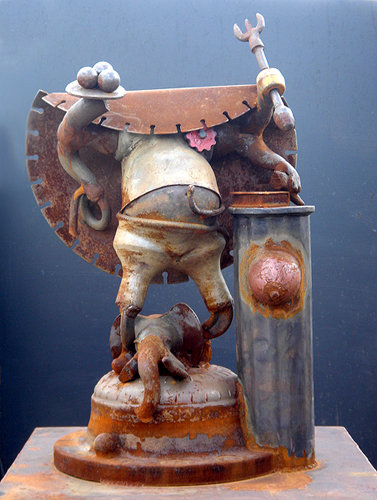
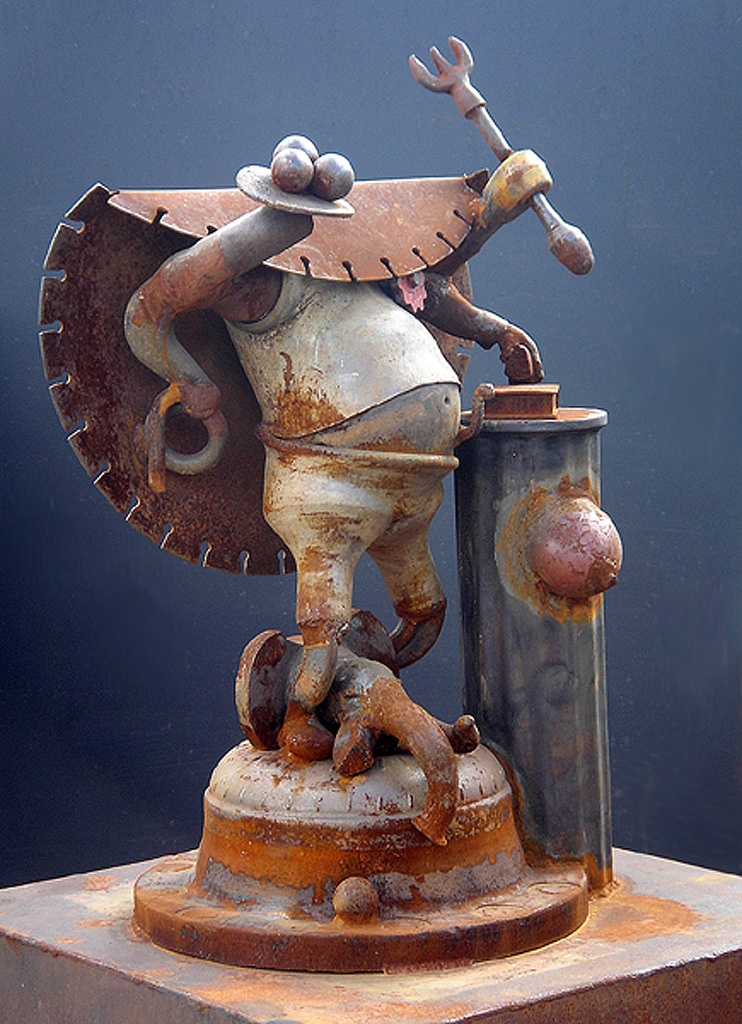
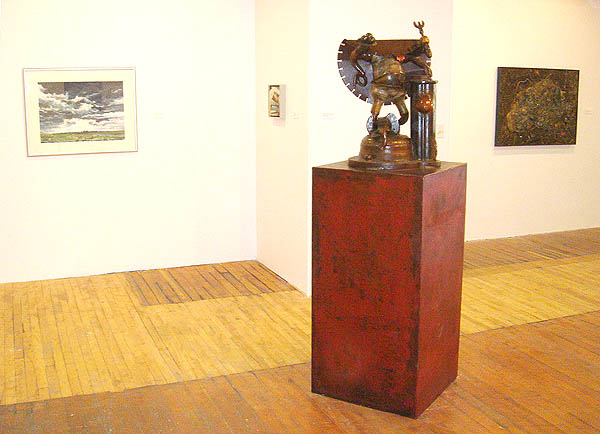
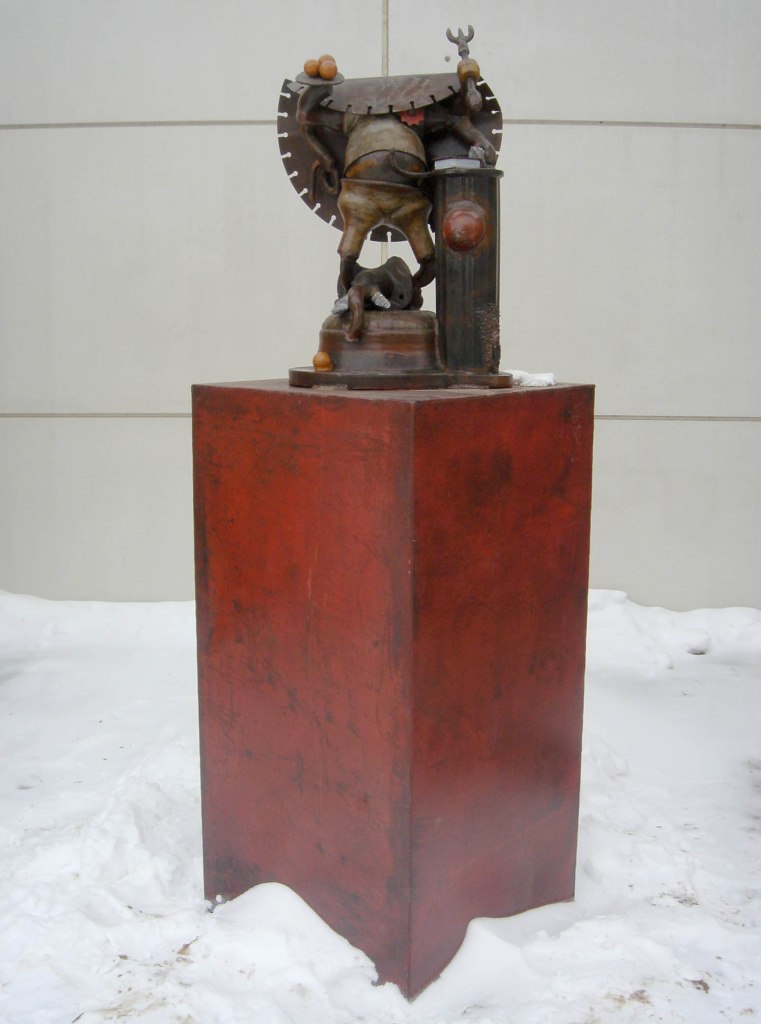
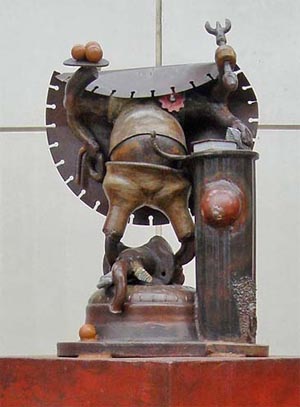
The work isolates the interval between decapitation and resurrection, the act by which Ganesha achieves his final form only by first being killed. In the source narrative, most fully told in the Shiva Purana, Parvati makes the boy from her own body alone, with no involvement from Shiva; encountering a child he had no part in, Shiva beheads him for refusing entry. Parvati’s grief forces the revival, and the head of the first creature found facing north, an elephant, is fixed to the boy to complete him. What results is not the same being restored but a different one: the son Parvati made does not survive to become the god later worshipped, he has to die first, and Ganesha proper begins only at the graft. The sculpture holds the figure in the space between those two beings, the wholly maternal creation already ended, the composite god not yet assembled.
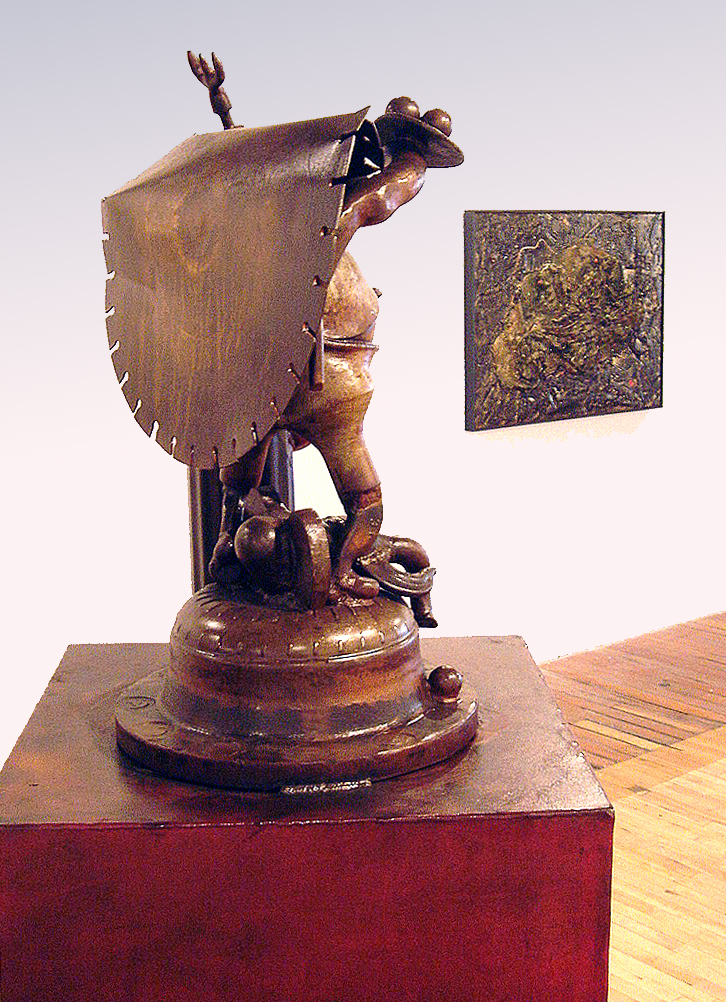
Beside the figure, a pillar carries a breast and a vulva, Parvati’s body made explicit as the column itself: the site of a creation that was hers alone, complete, and needing nothing from Shiva. Set against this, the saw blade hanging down the figure’s back, bending over the severed neck, and settling across the chest is Shiva’s sole material contribution to the same body, arriving only at the killing. The blade reads simultaneously as weapon, wound-dressing, royal mantle, and halo of divinity, one uninterrupted shape whose function shifts only with its position against the body, so that violence, care, sovereignty, and sanctity register as a single event rather than a sequence. The sculpture stages Ganesha’s origin as a literal division of authorship: a maternal column standing apart from a paternal weapon, joined only by the headless figure caught between them.
A trident is raised in one hand, the attribute of the father this death is in the process of supplying; a plate of sweets is held in the other, an inheritance not yet his by blood held alongside an offering that already is. Below, the elephant head that will complete the figure lies unattached, its trunk directed toward a single fallen sweet on the ground, appetite already oriented toward a continuity the body hasn’t yet acquired. The mouse, his eventual mount, sits apart at the base, waiting for a rider who does not yet exist in the form that will need him.
Titled a reawakening rather than a beheading, the piece fixes on the instant a killing becomes a birth: a body caught standing between the mother who made him whole and the father who is about to remake him, waiting on the head that will render him, for the first time, Ganesha.

