Welded steel, 11 x 39 x 43, 2003.
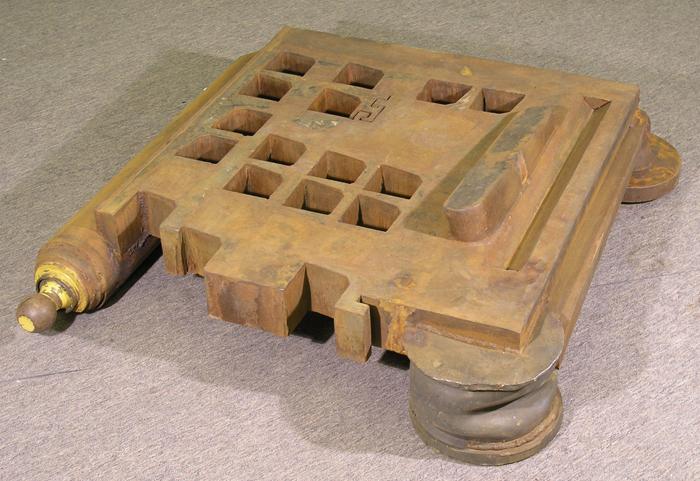
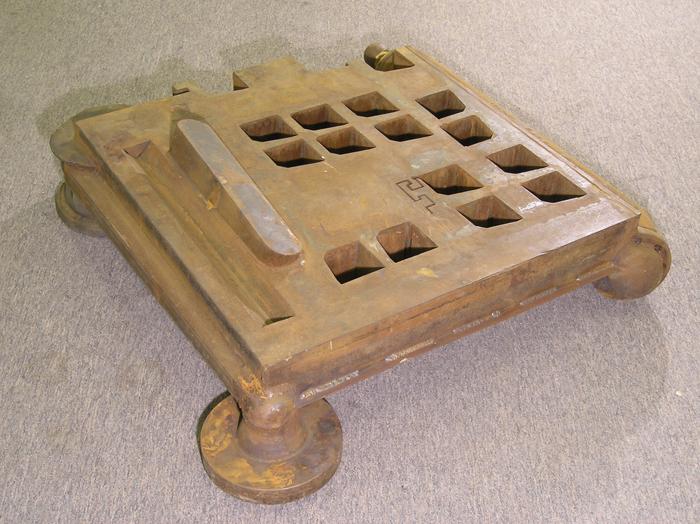
Atlas is the Titan who holds up the sky, and the sculpture keeps only the part of him that holds. It has no figure and no strain: what remains is a base, a thick slab on stout feet, made to receive something and give it a firm seat. A base is defined by what it expects, and this one shows what that is in its surface. Square pits are sunk into one end, a long groove with a raised bar runs along one side, and a ball-tipped cylinder projects from one end. They read as the sockets, keyways and fittings of a hot shoe or a coupling, cut so that another piece with matching tabs could seat on top and lock. The load is absent, and the slab describes it by the places where it would attach.
The same surface reads as a map. The pits form a grid like the squares into which a map is divided, and the groove with its bar lies across it like a road or a ridge. A small Greek key sits among the pits and ties the slab to the myth’s own country. Read this way, the slab is a book: thick, flat and closed on a table, with the world on its page. An atlas is also the name of that book, so the title carries two meanings at once. One Atlas holds the world up and the other holds it in.
Both readings end in the same object. The slab is low to the floor, and a viewer looks down on it from standing height, as one looks at a book laid on a table, and walks around it as one walks around a plinth. As a socket it waits for a piece that is missing. As a book it holds a world that has been laid out flat. Either way it is the support that the world sits on and the place where the world is kept.

