
Soldered brass, copper, 21 x 17 x 9, 2022.
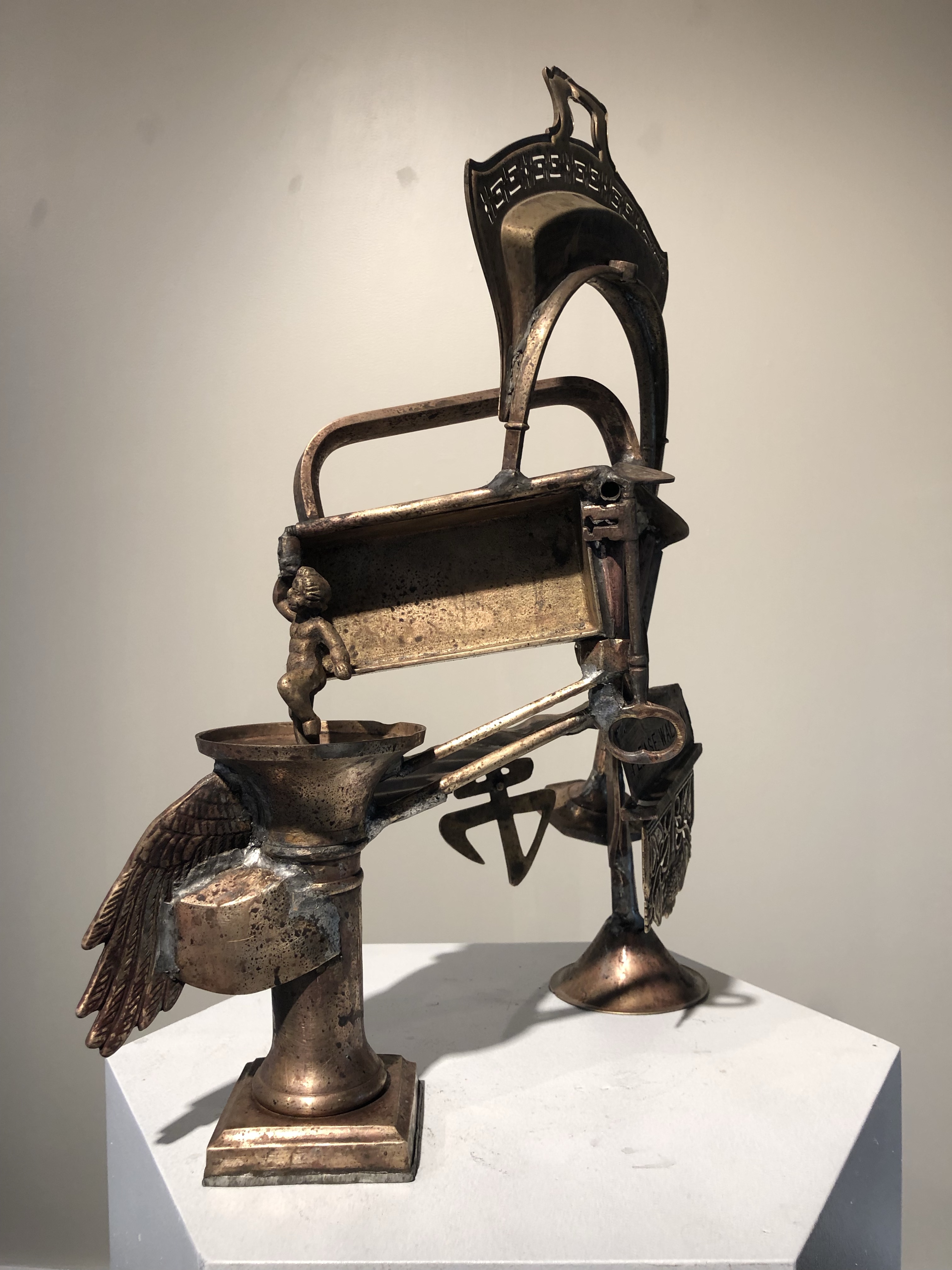
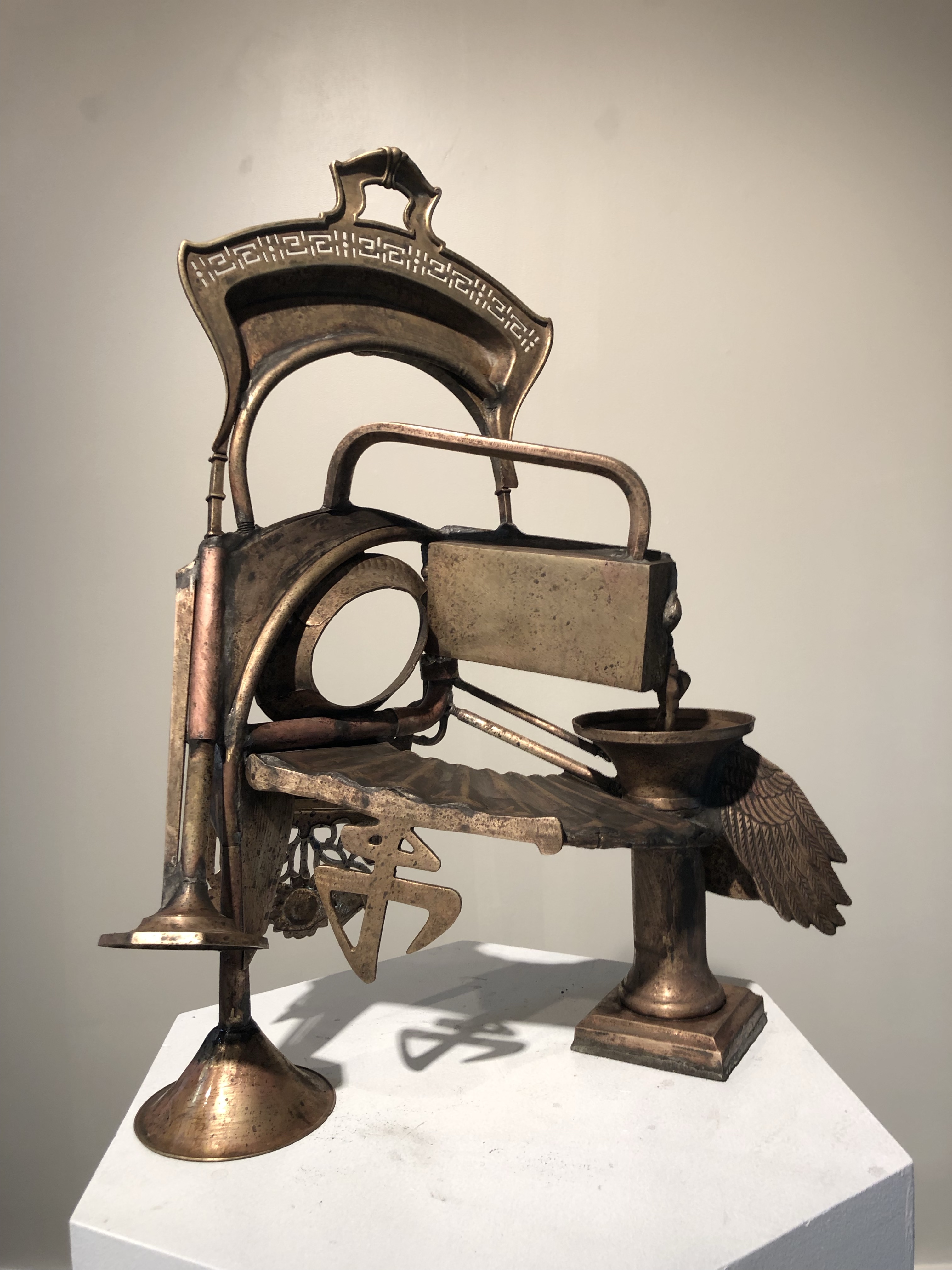
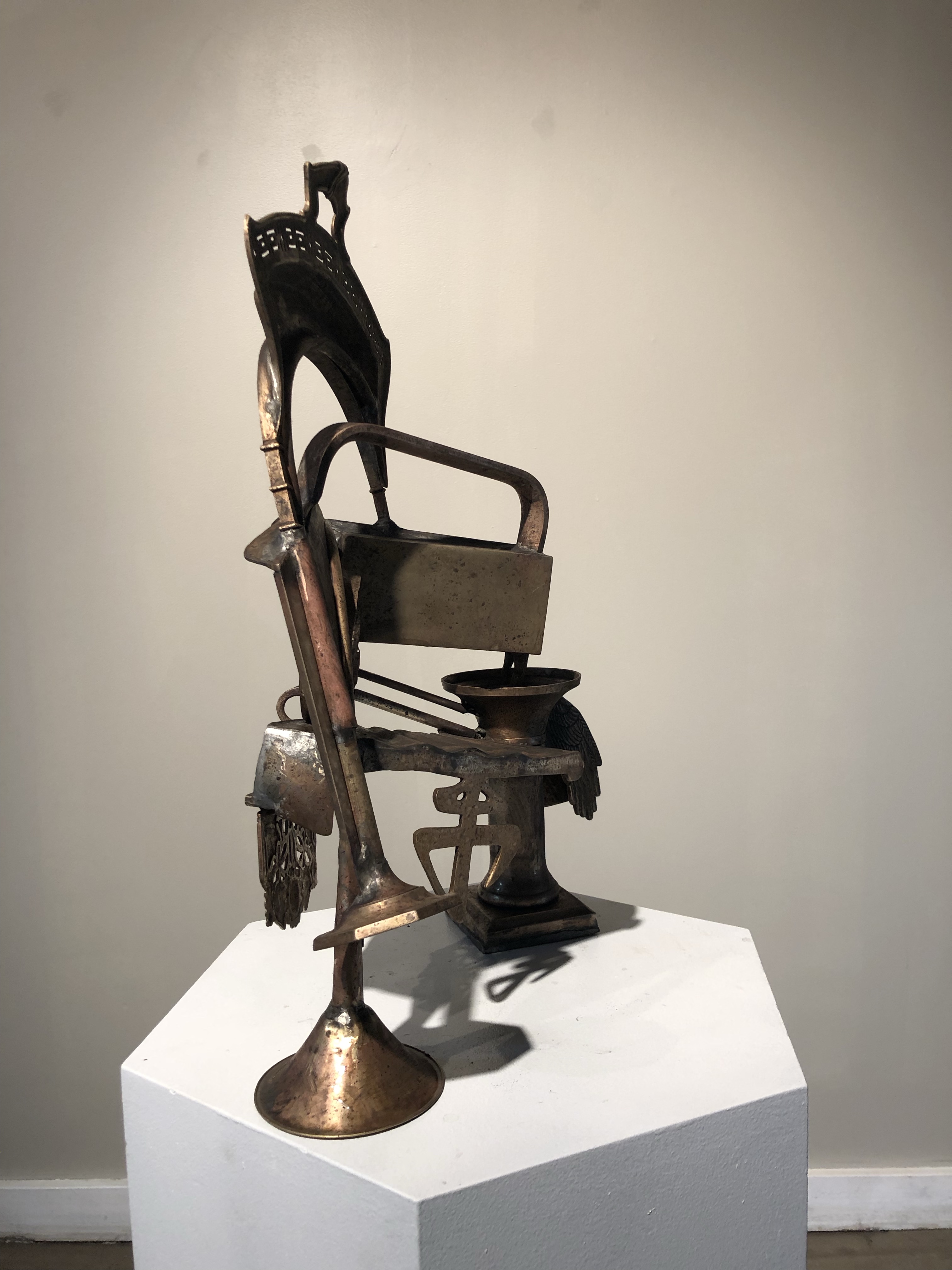
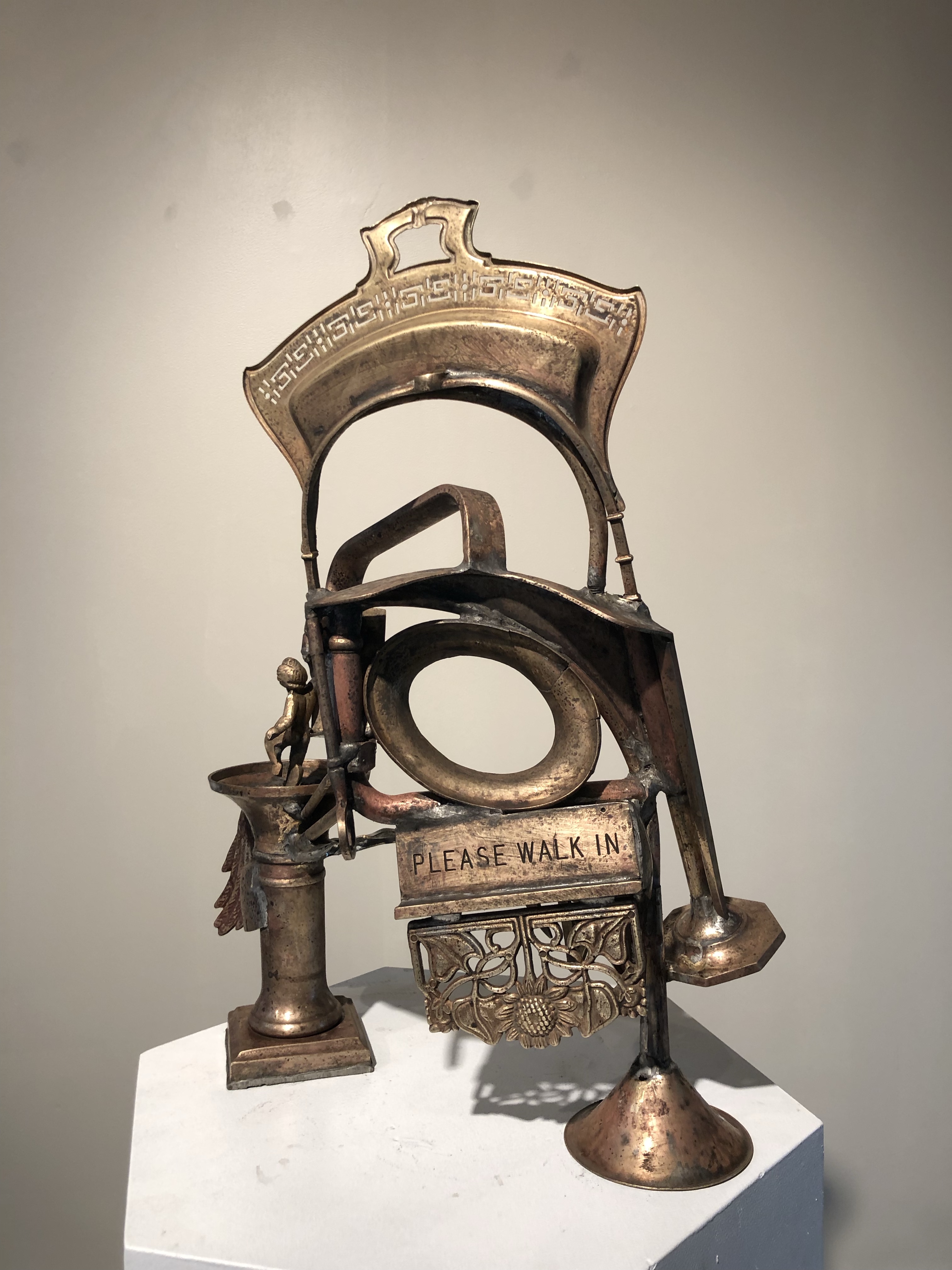
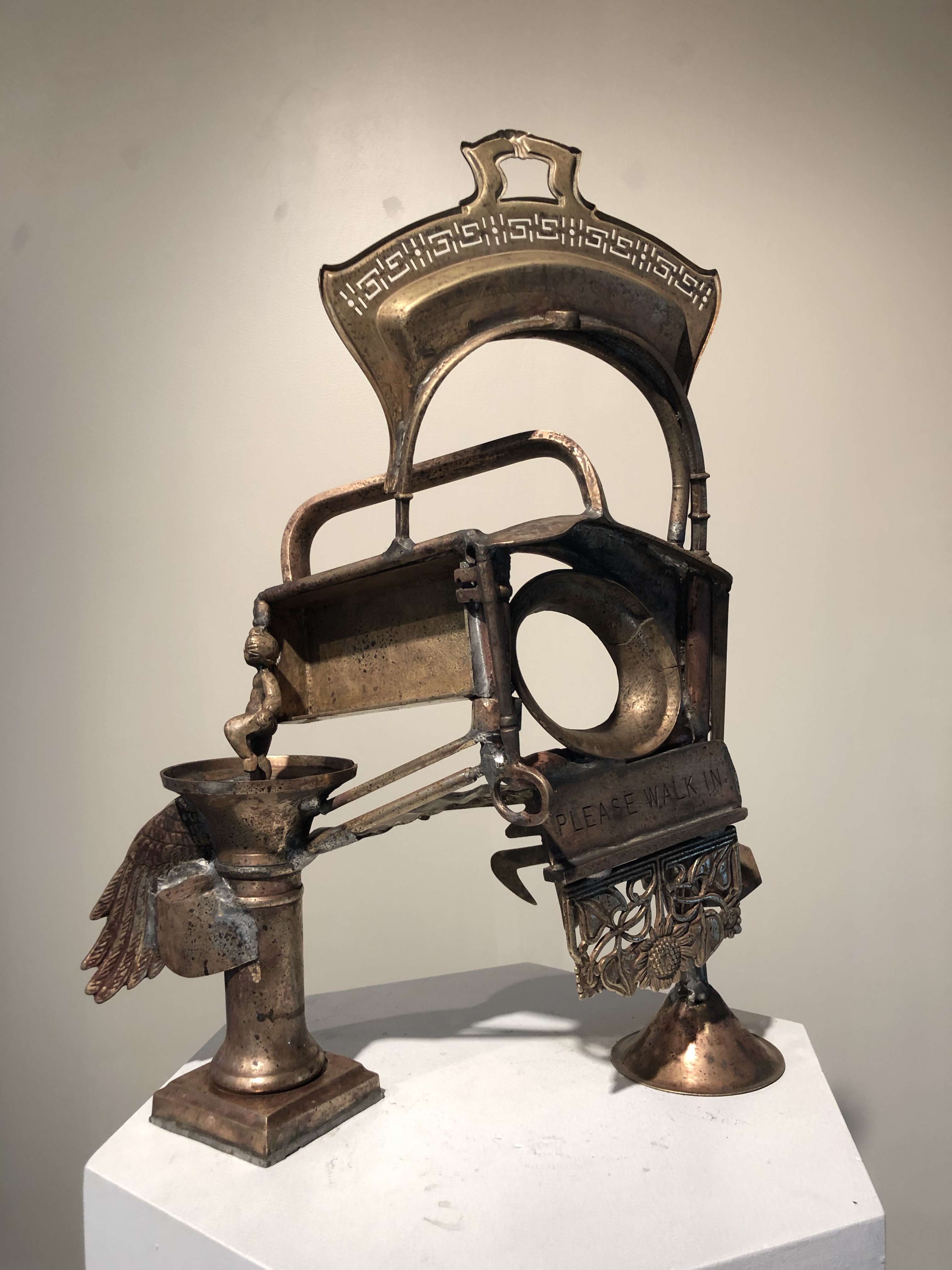
The title names the earthly paradise as the twentieth century invented it. James Hilton coined Shangri-La in his 1933 novel Lost Horizon for a hidden Himalayan sanctuary of peace and long life, a Western fantasy of Tibetan and Chinese spirituality, and the name has since passed into the vocabulary of hotels and resorts. The sculpture constructs that place out of its own kind of materials: souvenirs and fittings. The roof is Chinese-styled, with a bamboo handle. Its border is the Greek key, a meander that Greek and Chinese ornament developed independently, so the pattern belongs equally to both traditions and stands as the emblem of the cultural crossing. The cast ideogram is an East Asian script used as decoration. The sunflower panel is Art Nouveau, a Western style that itself absorbed Japanese design. Every component is a Western reception of the East or an Eastern idiom assimilated by the West, and the paradise they build has no original, only a chain of images of it.
The sign carries the work’s irony. It is the only legible text in the sculpture, and what it says is a shopfront formula. The invitation is hospitable and unattended: no keeper, no threshold ritual, no ordeal, only the retail courtesy of a door left open. The path it recommends is literal. A corrugated gangway slopes beneath the circular gate, and the gate is an aperture a few inches across. At this scale the only figure able to accept the invitation is the putto, who waits on the opposite side of the work in a basin on a winged column, nowhere near the gate. The invitation is general and the entrance is particular, and the viewer’s body is too large for it. The utopia can be seen, entered only as an idea, and sold in the language of the hospitality trade.
Formally, the work sets linear elements against solid ones. The tubing arch, the loop handle, and the rod-like members that cross the composition operate as the drawing in space associated with Julio González, while the ring, the bar, and the tray supply mass. The central aperture carries the composition, as the void does in much open-form welded sculpture from David Smith to Anthony Caro, and the two-footed support gives the structure a poised, almost walking balance.

