Painted steel, cast iron, brass, 66 x 23 x 21, 2006.
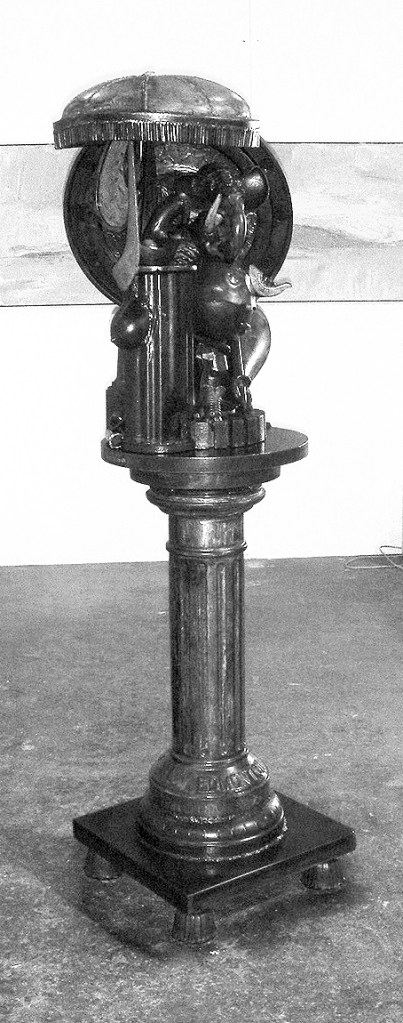
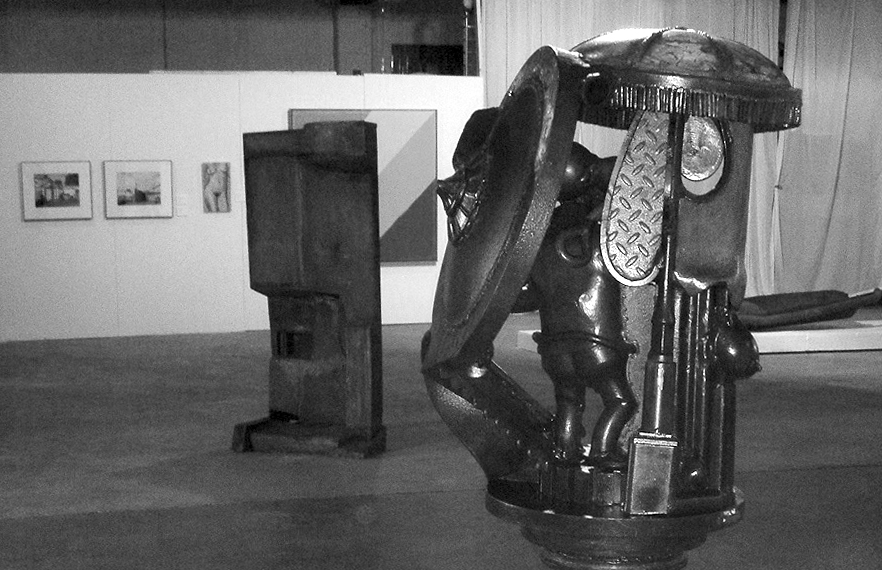
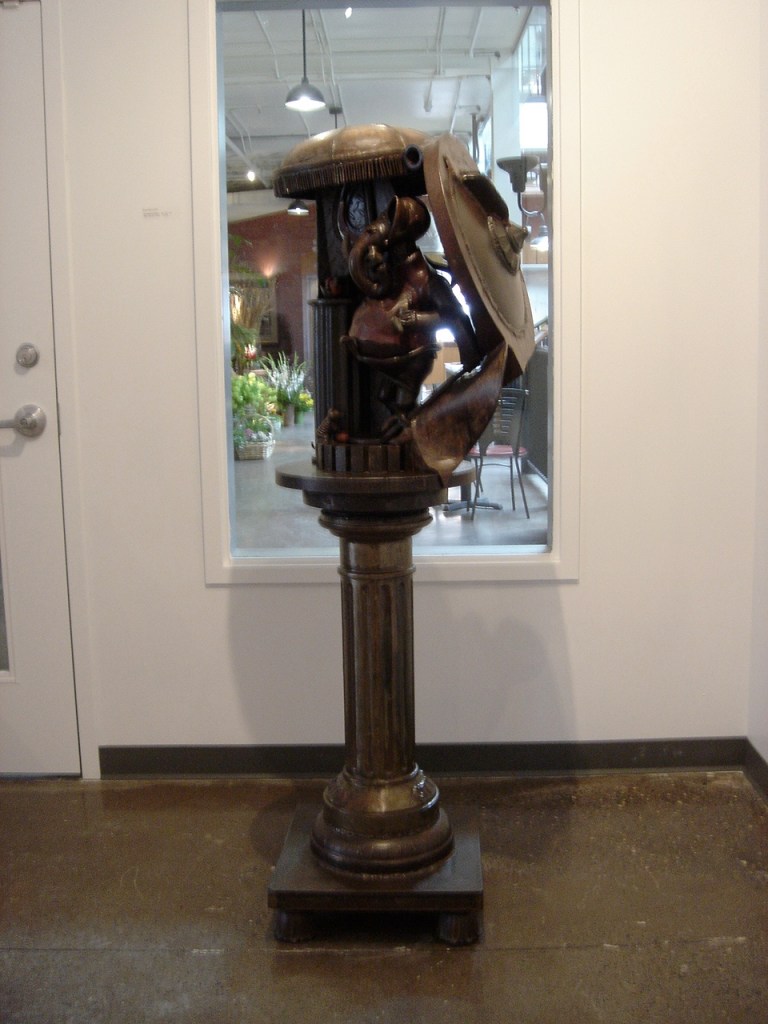
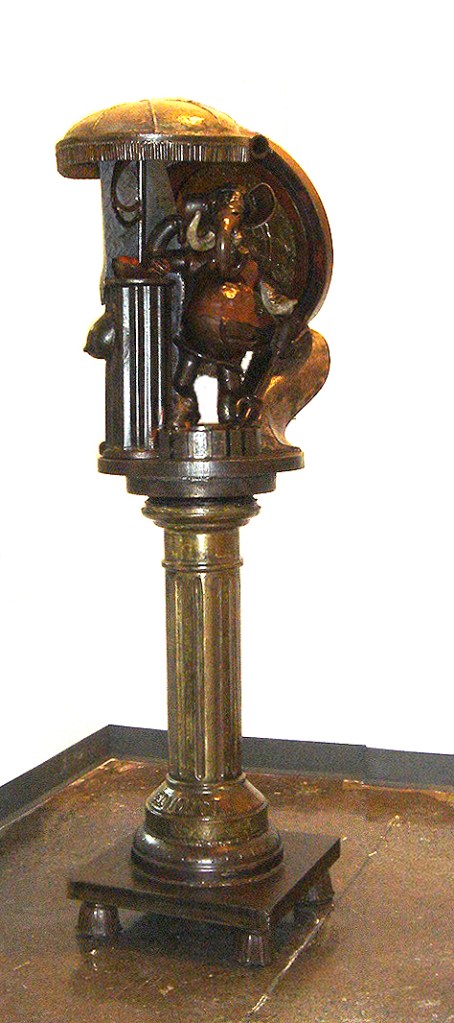
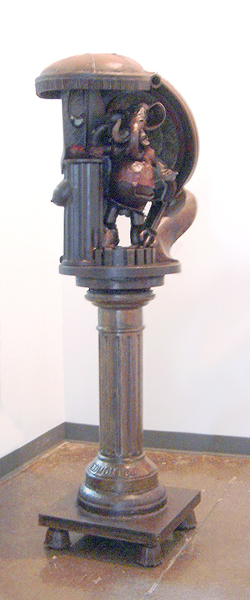
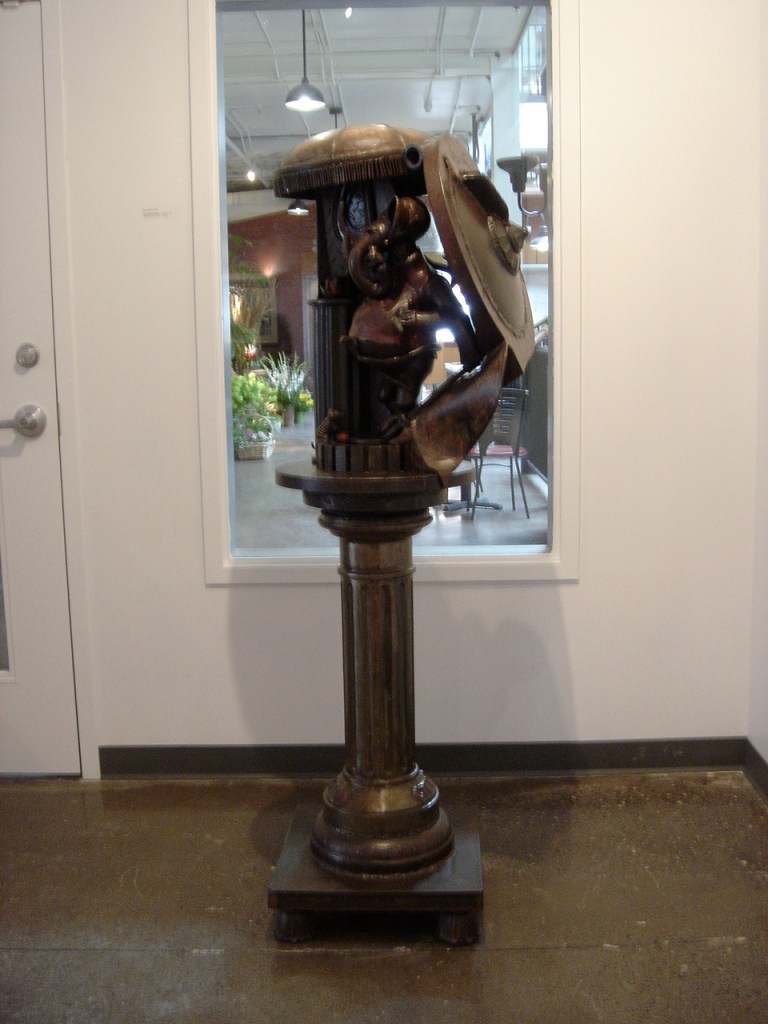
Ganesha the Oracle sets a fully-attributed, iconographically literate Ganesha atop a municipal bollard cast for the City of Edmonton. The god carries his four canonical implements: the trident inherited from his father Shiva, the tusk broken and repurposed as a stylus for transcribing the Mahabharata, the modaka held in reserve as an emblem of desire mastered rather than indulged, and the noose used to draw devotees toward truth or to bind the obstacles he is invoked to remove. A snake cinches his stomach, a detail drawn directly from the myth in which the moon mocks his overeating and he binds his splitting belly shut in response; the same myth surfaces again in the crescent moon on the banner beside him. At his feet, the mouse, his vahana and the sculpture’s clearest sight gag, has commandeered the modaka itself, presented as a socketed, freely spinning ball in direct citation of the pearl held in a Chinese guardian lion’s mouth, ego and appetite handed the very object that gods sacrifice.
The syncretism is deliberate and doubled. Ganesha’s tilaka fuses the Vaishnava urdhva pundra with the Shaiva tripundra, compressing onto one forehead the sectarian reconciliation ordinarily depicted as a split-bodied Hari-Hara. The column beneath him carries a single exposed breast, a citation of Parvati, his mother and, via the Ardhanarishvara tradition, Shiva’s inseparable feminine half. Where Hari-Hara resolves Vishnu and Shiva, Ardhanarishvara resolves Shiva and Shakti; the sculpture cites both, one fused onto the god’s own body, the other displaced onto the ground he stands on. Above him, a red, fringed chatra, the ceremonial parasol of South Asian royal and processional convention, converts the whole assembly from a static enthronement into a single frozen instant of festival procession: an oracle mid-parade rather than an icon permanently seated.
That procession, however, is routed through entirely secular, Albertan civic and industrial material. The plinth is a cast-iron City of Edmonton bollard, anti-vehicle street hardware repurposed as a base for divinity. A brass zodiac wheel, Western rather than Vedic in its cosmology, stands in for a halo; on its steel reverse, a manufacturer’s “Made in Canada” stamp is left legible rather than ground away. The sculpture’s claim to universal, placeless, cosmological authority sits, quite literally, on top of an admission of its own specific municipal and industrial origin.
The result is not a devotional object, nor a satire of one, but an argument conducted through correct iconography: that systems of authority, sectarian, civic, cosmological, national, are interchangeable, mutually citable, and equally capable of being reforged, quite literally, from Alberta’s industrial scrap.

