
Welded steel, 78 x 67 x 20, 2002.
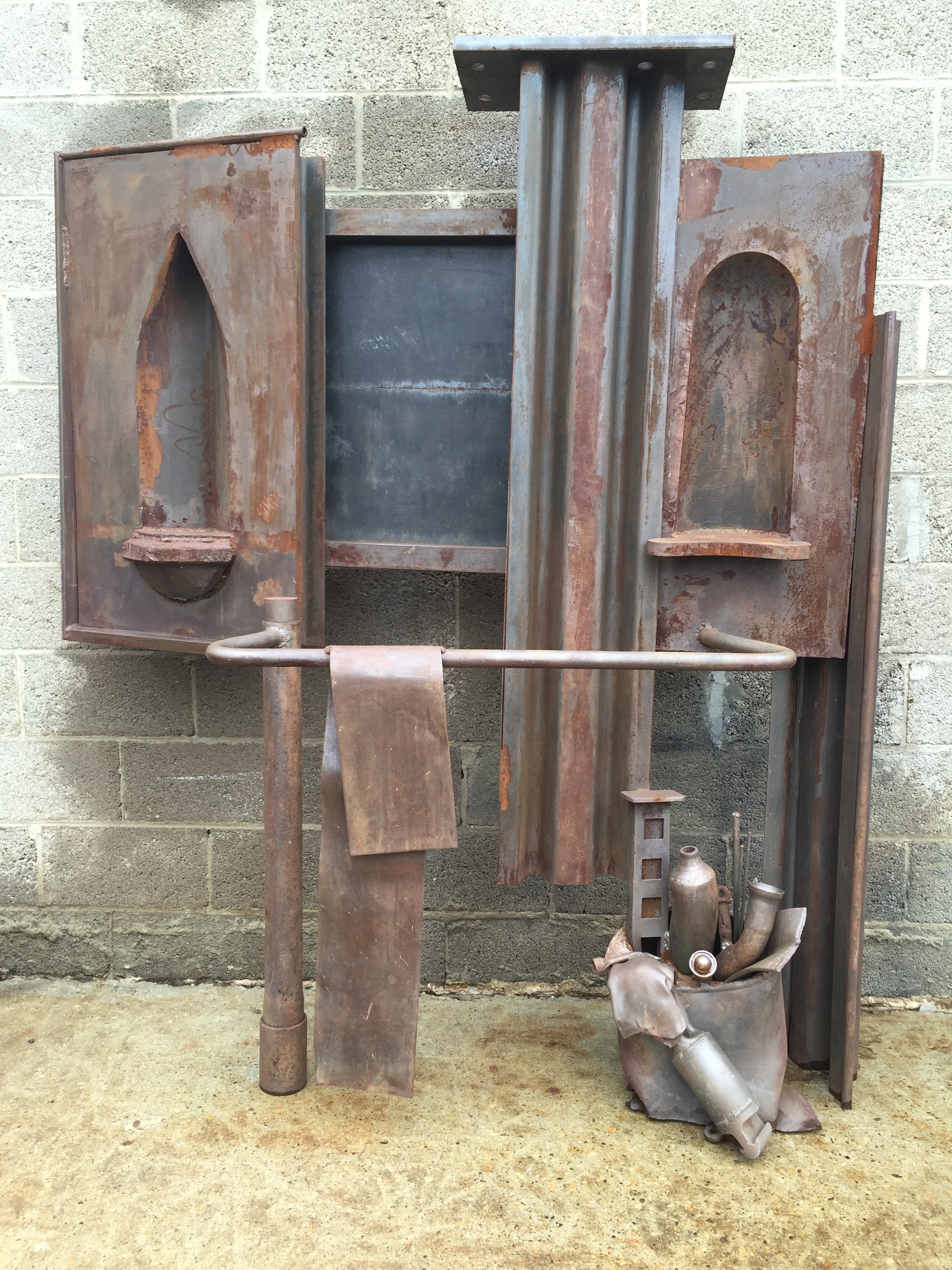
The subject. An allegory in the Enlightenment manner: a virtue triumphs over vices, with the parenthetical naming the defeated. What the title withholds is the personified Reason that tradition would have shown, a Minerva or a goddess of Reason with spear and book. In her place stands the blackboard, the instrument of instruction. Reason is represented by its apparatus.
The niches. Gothic and Romanesque niches are the architecture of the medieval cult of images, built for statues. Both are empty. The emptiness is the victory itself, which makes it a quiet one: nothing is smashed, so the sculpture shows no iconoclasm. The saints are simply not there, and the shelves remain. The pointed arch on the left and the round arch on the right don’t run chronologically in reading order. They function as a pair: two ecclesiastical styles of one authority, flanking the classical column that sits between them. A fluted shaft with a capital is the language of Renaissance and Enlightenment architecture, the building tradition that returned to antiquity’s rational orders. Reason’s architecture stands between the faith-architectures that precede it.
The blackboard. Centered, flat, framed, and blank, it is the only surface in the work not given over to a shrine. Its blankness reads as a lesson not yet written, or a tabula rasa, and it occupies the position a devotional image would occupy in a triptych. The kind of image replacing the sacred one is a surface for inquiry.
The cluster. The lower right can be read through a specific convention: the trophy. Victory monuments from Rome through the Baroque heap captured arms and armor at the base of the column. Here the spoils are vessels, spouts, the defeated party’s paraphernalia piled at the foot of the victor’s column. This also explains why only this part looks accumulated: spoils are gathered, whereas monuments are built.
The towel rail. Reason’s triumph is shown as housekeeping, which is consistent with “quiet.”
Formal lineage. The piece leans on a wall and is frontal, assembled from planes and standard sections: a relief-sculpture in the line from Cubist construction through David Smith to Nevelson’s reliefs and Hide’s wallbound works. That inheritance supplies the grammar, and the allegorical title sets an Enlightenment subject inside a modernist syntax. The sculpture-as-painting comparison holds here: it is composed like a picture, with a tonal field in the center, flanking vertical masses, and a still life in the lower corner.

