Welded steel, 21 x 64 x 118, 1999.
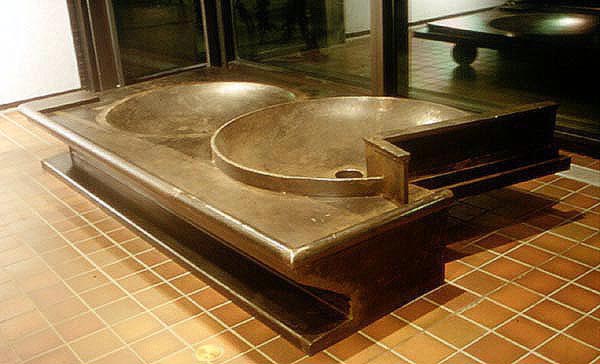
The form of the sculpture reads as a ritual table. It’s long and low, about ten feet by five and under two feet high, a height at which a person would stoop or kneel to reach what’s on it. The top is a thick slab edged with a lip and raised on a recessed base, so it hovers slightly over its shadow. A stepped ledge runs along one end, and a short wall stands behind the smaller basin like the back of an altar. Nothing on the surface stands up except that wall, and everything on it is hollowed to receive. A table built like this is made for offerings, and what it offers is a pair of stars.
Dogon cosmology, as recorded by the French ethnographers Marcel Griaule and Germaine Dieterlen in the 1940s and 50s, includes a tiny, dark and extremely heavy companion to Sirius, which the Dogon call po tolo. Astronomy confirms a companion of that kind: Sirius B is a white dwarf, minute beside Sirius A and enormously dense, and it circles its partner about once every fifty years. How the Dogon came to know of it is disputed, and the sculpture takes no side.
Two basins are let into the slab. The larger lies flush with the surface at one end, broad and plain. The smaller sits on a raised rim of its own with a notch cut in its edge and a small hole beside the lip, and these are the features of a vessel for pouring or draining. The big body is simple, the small one is the particular one, and the table sets it apart from its partner. Both are bowls, the shape a rite uses to hold what’s poured out for it, and both lie within reach of someone standing at the table’s edge. The star pair is set out as an altar, with the larger and smaller bodies as the things attended to, and the viewer takes the officiant’s place over them.

