Welded steel, 49 x 39 x 67, 1998.
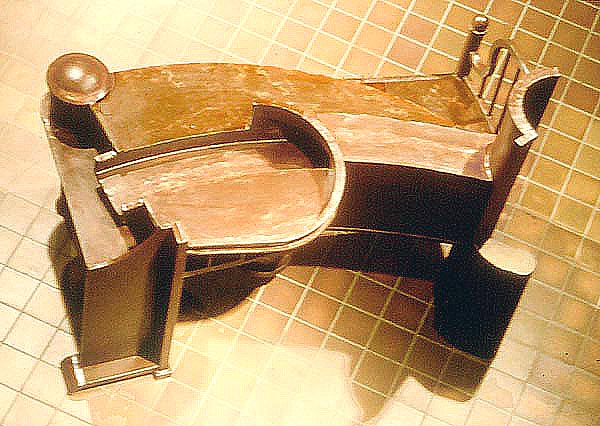
Night Music fuses two domestic objects, a bed and a piano, and lets each interrupt the other. The bed is in the details. A rail of thin spindles ends in a ball finial at the back like a headboard or the side of a crib. At the left a turned leg carries a domed cap like a bedpost, and on top of the body a rounded hollow with a sloped floor is shaped to hold a sleeper. Two cylinders stand at the right end, one tall and one short, in the place where bolsters would lie. The piano is in the body and the feet. The long case curves in plan the way a grand piano’s rim curves, and pedals hang beneath it. The bed’s posts and rail are laid over a piano’s outline, and the result matches neither.
Dreams join things like this. A bed you can’t lie on because it is a piano, and a piano you can’t play because it is a bed: one object has the functions of both and can perform neither. The pedals sit at the left end, hanging by a cord beneath the case. They are the part of a piano that sustains a note and softens it, and here they connect to nothing, in a body that has no keys and no strings. What they would control is missing. Night music is also what sleepers hear with no player present, and the sculpture puts the sleeper’s place and the musician’s place in one low, curved body.
The room has no occupant. No one lies in the hollow and no one sits at the instrument, and the furniture is left arranged for both.

